
Validation Red Flags: When to Pivot or Quit
Validation Red Flags guide for first-time founders: warning signals, pivot vs persevere decisions. Use clear steps, evidence checks and practical prompts before spending heavily.
Summary
Validation Red Flags gives first-time founders a practical way to handle warning signals, pivot vs persevere decisions. The goal is to make the next decision visible: what to check, what evidence matters, what action fits this stage, and what to leave out until the signal is stronger.
Validation Red Flags guide for first-time founders: warning signals, pivot vs persevere decisions. Use clear steps, evidence checks and practical prompts before spending heavily. Use this page as a working guide: read the summary, choose the relevant checkpoint, and turn the next decision into a small evidence step.
The method pairs well with the broader F/MS Startup Game library because every guide keeps the same pattern: clarify the customer, reduce the scope, test a real behavior, and decide from evidence.
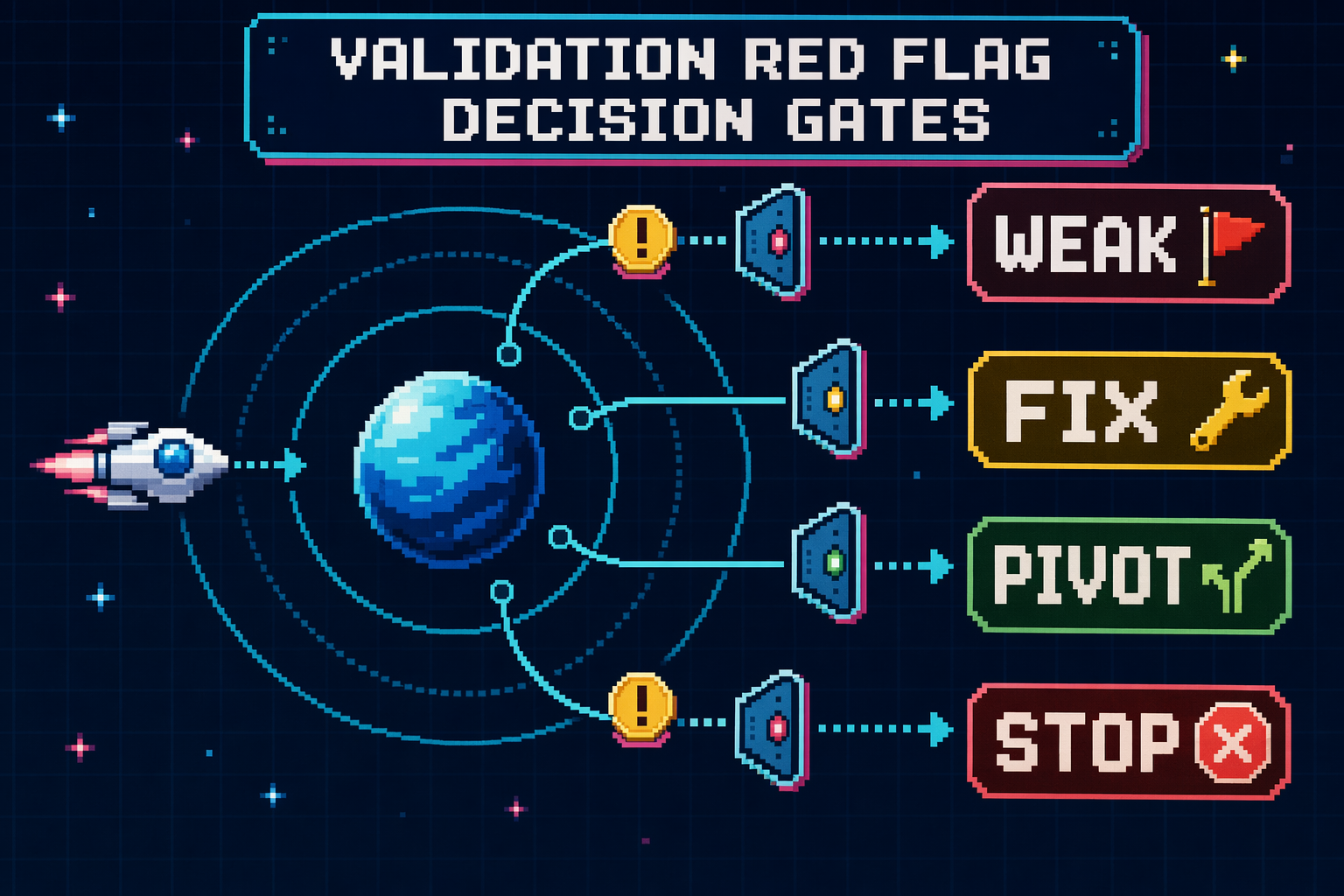
Why Validation Red Flags Matters
Validation Red Flags matters because first-time founders lose the most time when a decision feels obvious before the evidence is clear. The work in this guide turns warning signals, pivot vs persevere decisions into a visible sequence of choices, checks and next moves. It is written for founders who need practical movement without turning every decision into a giant research task.
Use the startup validation red flags, when to pivot startup lens to keep the discussion grounded. A good page of notes should show who the customer is, what trigger makes the need urgent, what proof already exists, what action comes next, and what you will stop doing until better evidence appears. That discipline keeps momentum high while reducing expensive guesswork.
For example, a founder using this guide starts with the customer situation, names the evidence needed, and chooses the smallest next action that reveals the truth. The same pattern works across early startup work: listen the current reality, measure the smallest useful option, commit with real people, and decide based on what happened rather than what sounded exciting in a planning session.
When To Use This Guide
Start by narrowing the situation. A broad audience creates soft answers, while a specific segment gives you stories with names, timing and consequences. If the answer could apply to almost anyone, it is too vague for early execution.
Write down the trigger that makes this topic important now. The trigger might be a sales call, a signup, a deadline, a cash crunch, a confusing tool choice, a legal setup step, or a founder capacity limit. Clear triggers make the next step easier to choose.
The useful question is not whether the topic is interesting. The useful question is whether a founder has enough evidence to act this week. When the answer is unclear, reduce the scope until the next action is small enough to test.
Warning signals, pivot vs persevere decisions blocks the next founder decision and the current notes feel too broad to act on.
The decision is already proven by recent customer behavior, payment, repeated usage or a clear operating habit.
The Practical Method
A practical method has four parts: define the customer, name the painful moment, choose a small test, and record the result. Skipping any part creates a false sense of progress. The founder might feel busy while the evidence stays thin.
Treat each choice as a checkpoint. If the customer is unclear, interview first. If the pain is unclear, listen for recent behavior. If the offer is unclear, write a narrow promise. If the buying path is unclear, ask who approves, pays, or blocks the decision.
Keep the method simple enough to repeat. A founder who repeats the same check across several conversations learns faster than a founder who changes the frame each time. Repetition makes patterns visible.
- listen the current situation in the customer’s own words.
- measure the smallest useful option before adding scope.
- commit with a person who feels the cost now.
- decide after the evidence is written down.
Score The Evidence
Scoring helps remove drama from the decision. Give each signal a low, medium or high score, then write the evidence beside it. A score without a note is just a feeling. A note with a recent story is useful.
Look for behavior over opinion. Search, payment, manual work, referrals, repeated complaints, urgent deadlines and saved budget all carry more weight than polite approval. A founder should respect enthusiasm, but should not count it as proof on its own.
When the score is mixed, split the audience or reduce the offer. Mixed evidence often means two customer groups were combined, the promise is too broad, or the next test asks for too much commitment too early.
Scripts And Prompts
Use prompts that invite detail. Ask about the last time, the steps taken, the cost of delay, the current workaround and the person responsible for solving it. These prompts keep the conversation anchored in real events.
A good prompt does not push the customer toward your preferred answer. It gives the other person room to describe what happened before you offered a solution. That is where the most useful copy, objections and product clues appear.
After each conversation, separate exact quotes from your interpretation. Exact quotes become copy and positioning material. Interpretation becomes a hypothesis that still needs a second check.
Common Mistakes
Most mistakes come from moving too fast into certainty. Founders count friendly words, accept vague praise, build for a blended audience, or keep adding features to avoid a harder sales or validation step.
The fix is not more complexity. The fix is better boundaries: one customer group, one painful moment, one test, one success signal, and one decision after the test. Boundaries make the work feel smaller and more honest.
If the evidence does not support the current idea, that is still progress. The goal is to learn before the cost rises. A clean no is cheaper than a beautiful version no one needs.
Your Next Move
Connect this guide to the wider startup path. Use it with validation guides when the pain is unclear, MVP guides when the first version is too large, strategy guides when the business logic is fuzzy, and operations guides when repeated work needs structure.
The next useful step should fit on a single page. Write the customer, the situation, the signal, the test, the owner and the decision date. If that page looks vague, the next move is more learning. If it looks specific, the next move is action.
Keep returning to evidence. Every founder has moments when the work feels noisy. A simple evidence habit turns the noise into choices and keeps the startup moving in a direction customers actually understand.
Field Playbook
Treat validation red flags as a working decision, not a broad learning topic. The reader should leave with a page of evidence, a small test, and a decision rule. Start by naming the exact situation: weeks of effort produce compliments, low follow-through, and no clear buyer behavior. If that sentence feels vague, the work is not ready for a bigger spend or a larger build.
Anchor the work in a narrow audience: founders reading mixed signals and deciding whether to keep testing, narrow the segment, or stop. A useful audience shares a trigger, vocabulary, buying context, and constraint. When those pieces are missing, feedback gets soft and the founder starts accepting comments that sound supportive but do not change behavior.
Write the current workaround before writing a better answer. In this case, the current workaround often looks like more interviews, more features, a bigger audience, and softer success criteria. That workaround tells you what the customer already tolerates, what feels too painful to ignore, and which habit a new answer must replace.
Define the proof signal early: the same segment gives repeated behavior strong enough to justify another test. This signal should be visible from behavior. Good signals include payment, repeated use, a sent intro, a signed pilot, a completed task, an accepted price, a clean handoff, or a support issue that repeats across users.
Run the first test small: a red-flag review with stop, narrow, and continue rules written before the next effort. Small does not mean vague. It means the test has one audience, one action, one owner, one review date, and one success condition. A founder who cannot write those five parts is not ready to scale the work.
A founder hears ten people say the idea is interesting. Nobody shares data, takes a call with a buyer, joins a pilot, or names a real cost. That is not neutral. It is a signal to change the segment or stop the current line of work. Use this kind of concrete case to keep validation red flags practical. If the example cannot show the customer, action, cost, and evidence, rewrite it until those pieces are visible.
Write the exact decision validation red flags should support. If the decision is unclear, the section becomes education instead of useful work.
Collect proof tied to behavior: the same segment gives repeated behavior strong enough to justify another test. Keep quotes, actions, and interpretations in separate notes.
Use a red-flag review with stop, narrow, and continue rules written before the next effort. The test should be small enough to run before momentum turns into guesswork.
Measure signal quality and decide what changes next. No review means the work becomes another saved idea.
Working Worksheet
Use this worksheet before adding tools, features, money, or more content around validation red flags. The worksheet forces the founder to connect the topic to a customer action, a business constraint, and a concrete review date.
Every answer should be specific enough that another person could challenge it. A broad answer such as “founders need this” is not useful. A better answer names the segment, the moment, the current workaround, the cost, and the next behavior you expect to see.
- Audience: write the narrow group for this guide, using the frame “founders reading mixed signals and deciding whether to keep testing, narrow the segment, or stop”.
- Pain moment: write the event that creates urgency, based on “weeks of effort produce compliments, low follow-through, and no clear buyer behavior”.
- Current workaround: list the manual work, tool, template, person, or delay used today.
- Cost: write what the current state costs in time, money, trust, focus, legal risk, or lost revenue.
- Owner: name who feels the pain, who approves the change, and who blocks it.
- Proof signal: write the behavior that counts as progress: the same segment gives repeated behavior strong enough to justify another test.
- First test: choose the smallest test: a red-flag review with stop, narrow, and continue rules written before the next effort.
- Success rule: write the number, action, or response that means the test earned another cycle.
- Stop rule: write the weak signal that means the founder should narrow, change, or stop.
- Next review: assign a date, owner, and one metric for signal quality.
Worked Example
Imagine a founder working on validation red flags. The early impulse is to make the topic look complete: more pages, more tools, more features, more options, or more polished language. That impulse feels productive because the work becomes visible. It is risky because visible work can hide a weak customer signal.
The founder starts with the actual painful moment: weeks of effort produce compliments, low follow-through, and no clear buyer behavior. They write it in customer language and remove any phrase that sounds like a solution pitch. This matters because a founder cannot test the right thing while using words customers would never say.
Next, the founder studies the workaround: more interviews, more features, a bigger audience, and softer success criteria. The workaround shows how much friction people already accept. If nobody has a workaround, the pain might be softer than expected. If several people have similar workarounds, the first offer can focus on making that existing behavior faster, clearer, safer, or cheaper.
The first test is intentionally small: a red-flag review with stop, narrow, and continue rules written before the next effort. The founder does not try to prove every part of the business at once. They pick the riskiest assumption and run the smallest test that could reveal the truth.
The result gets reviewed against one proof signal: the same segment gives repeated behavior strong enough to justify another test. If the signal appears, the next cycle gets more precise. If it does not appear, the founder changes the audience, changes the offer, reduces scope, or stops before the cost grows.
- Write the current version of validation red flags in one sentence.
- Rewrite the sentence using customer language rather than founder language.
- Name the segment that most clearly feels “weeks of effort produce compliments, low follow-through, and no clear buyer behavior”.
- List the exact workaround: more interviews, more features, a bigger audience, and softer success criteria.
- Choose the proof signal: the same segment gives repeated behavior strong enough to justify another test.
- Run the first test: a red-flag review with stop, narrow, and continue rules written before the next effort.
- Record what people did, not only what they said.
- Separate exact quotes from founder interpretation.
- Decide whether the next cycle should narrow, continue, change, or stop.
- Move every unrelated idea into a parking lot until the current signal is clear.
Decision Rules
Continue when the same segment gives repeated behavior strong enough to justify another test. Do not continue because the topic feels important. Continue because a real person, in the right segment, took an action that makes the next cycle worth the cost.
Narrow when the pain exists but the audience is mixed. Different triggers, budgets, workarounds, or decision owners mean the page is hiding several segments. Split the segment before writing more copy, building more features, or spending more money.
Change the offer when the pain is repeated but the proposed relief does not earn action. The customer might care about the problem and still reject the way it is packaged, priced, timed, or delivered.
Stop when the only evidence is vague interest. Compliments, likes, saved posts, and friendly comments do not carry the same weight as payment, usage, a clear referral, or a real operational change.
Escalate only after the small test produces a clean read. Escalation can mean a stronger MVP, a paid pilot, a larger channel test, a formal SOP, a legal review, or a funding conversation. The next step should be earned by evidence.
Scripts To Use
Use these lines in interviews, sales calls, support replies, or follow-up emails. Keep the wording plain. The point is to get a useful answer, not to sound clever.
- What happened last time weeks of effort produce compliments, low follow-through, and no clear buyer behavior?
- What were you trying to get done at that moment?
- How do you handle it now: more interviews, more features, a bigger audience, and softer success criteria?
- What does the current way cost you?
- Who else feels the effect when this is not solved?
- Who approves a better way?
- What would make validation red flags urgent enough to act on this month?
- What would count as proof for you: the same segment gives repeated behavior strong enough to justify another test?
- What would make you hesitate?
- What did you try before this?
- What would you remove from the first version?
- What should happen next if this test works?
Counting interest as evidence before the same segment gives repeated behavior strong enough to justify another test. This creates confidence without behavior.
Trying to make validation red flags fit too many people at once. Mixed segments hide the strongest need.
Missing the person who feels the cost, approves the fix, pays for it, or blocks the change.
Running the test without a date to review signal quality. Evidence loses value when it is not read in time.
Quality Bar
A useful validation red flags page should give the founder a way to act this week. If the page only explains what the topic is, it is not finished. The reader needs a test, worksheet, script, score, and decision rule.
The quality bar is concrete evidence. Replace broad advice with specific customer situations, current workarounds, and observable behavior. In this guide, the key signal is the same segment gives repeated behavior strong enough to justify another test.
The content should help the founder avoid false progress. False progress looks like more pages, more features, more planning, or more tools without a stronger customer signal. Real progress changes what the founder does next.
Use the one-page test: after reading, the founder should be able to fill one page with audience, pain, workaround, proof, test, owner, metric, and review date. If that page is blank, the next action is more evidence, not more polish.
- Does the page name the audience as “founders reading mixed signals and deciding whether to keep testing, narrow the segment, or stop”?
- Does it explain the painful moment: weeks of effort produce compliments, low follow-through, and no clear buyer behavior?
- Does the worksheet separate quotes, behavior, and interpretation?
- Does the first test match a red-flag review with stop, narrow, and continue rules written before the next effort?
- Does the proof signal match the same segment gives repeated behavior strong enough to justify another test?
- Does the reader know who owns the next action?
- Does the page show what to cut or delay?
- Is signal quality tracked with a review date?
- Are external references tied to practical decisions?
- Does the page avoid generic motivation and give usable steps?
One Week Review Loop
Use a weekly review while validation red flags is active. The review keeps the work from turning into scattered effort. Look at what happened in the last seven days, what customers actually did, what the founder learned, and which decision deserves attention next.
Start with evidence before opinion. Pull exact customer quotes, sales replies, usage notes, payment signals, support questions, cancellations, delays, and founder time logs into one place. Then sort them by signal strength. Behavior sits above praise. Recent behavior sits above old assumptions.
The review should end with one decision, not a list of hopes. Choose whether to keep testing the same assumption, narrow the customer group, change the offer, reduce scope, pause spend, or move into the next validation step. A week with no decision usually means the evidence was not written clearly enough.
Keep the review short enough to repeat. Thirty focused minutes is better than a long monthly recap that arrives after the founder has already spent money in the wrong direction. Early startup work improves when review habits are small, honest, and hard to skip.
- Write the strongest evidence from the week in one sentence.
- Write the weakest evidence from the week in one sentence.
- Name the customer segment that produced the clearest signal.
- Name the customer segment that produced noise or weak intent.
- List the exact words customers repeated.
- List the action customers took without being pushed.
- Write the cost of continuing the current path for one more week.
- Write the cost of changing direction too early.
- Choose the next decision for validation red flags and assign a date.
- Remove one task that does not support that decision.
Use this review alongside mom test customer interviews for first time entrepreneurs and willingness to pay test pricing when the next action needs supporting context.
Reference Notes
These references shaped the practical checks in this guide. Use them when you want the source behind a method, then return to the worksheet above for the actual founder decision.
Keep each stage tied to real customer evidence. YC MVP guidance
Use customer jobs, pains, and gains to sharpen the next action. Strategyzer Value Proposition Canvas
Use market and competitor research when choosing a wedge. SBA market research guide
Make pages useful enough for real readers and search systems. Google helpful content guidance
FAQ
What is validation red flags?
Validation Red Flags is a focused startup guide for warning signals, pivot vs persevere decisions. It helps a first-time founder make the next decision with evidence instead of guesswork.
Who is this guide for?
It is for first-time founders, solo founders and small teams that need a clear next move before spending more time, money or energy.
When should I use this guide?
Use it when the topic blocks a real decision: what to test, what to build, what to spend, what to publish, what to document or what to stop.
What is the first step?
Write the customer segment, the current situation and the painful trigger in plain language. If those three items are vague, gather more customer evidence first.
How much evidence is enough?
Enough evidence shows a repeated pattern, a clear cost, a current workaround and a concrete next action. One friendly opinion is not enough.
What should I avoid?
Avoid broad audiences, vague promises, hidden assumptions, giant first versions and decisions based only on what sounds impressive.
How does this connect to customer interviews?
Customer interviews provide the raw stories, phrases and objections that make this guide practical. They reveal whether the topic matters in real life.
How does this connect to MVP work?
MVP work needs a tight promise. This guide helps define that promise before the first version becomes too large or too expensive.
How does this connect to pricing?
Pricing becomes easier when the customer pain, value and buyer responsibility are clear. Without that clarity, price tests produce noisy answers.
How do I know the audience is too broad?
The audience is too broad when people describe different triggers, different costs and different workarounds. Split the group until the pattern becomes visible.
What is a strong signal?
A strong signal is behavior: payment, manual work, repeated search, urgent complaint, referral request, saved budget or a real deadline.
What is a weak signal?
A weak signal is polite agreement with no recent story, no workaround, no budget owner and no reason to act soon.
Should I use a template?
A template helps if it makes the decision clearer. It should capture the customer, the evidence, the next test and the decision date.
How often should I review the evidence?
Review evidence weekly while the topic is active. Short reviews prevent old assumptions from driving new work.
What if the evidence is mixed?
Mixed evidence usually means the segment is too broad, the promise is unclear or the test asks for the wrong commitment.
What if customers already use another tool?
That is useful. Study where the current tool works, where it breaks, what still happens manually and what would make a switch worthwhile.
What if I have no audience yet?
Start with direct outreach, communities, founder networks and warm introductions. The goal is not scale yet. The goal is honest learning.
What should I document after using this guide?
Document the decision, the evidence behind it, the next action, the owner and the date when the result gets reviewed.
How do I keep the work small?
Limit the next step to one customer group, one painful moment, one promise and one success signal.
What should I do next?
Choose the next guide that matches the weakest signal: problem proof, payment proof, MVP scope, business model, operations, finance, legal setup, growth or founder focus.
Build from evidence, not noise. Start with the F/MS Startup Game homepage, then use each guide only when the next founder move needs sharper proof.
Open the Startup Game